- Your cart is empty
- Continue Shopping

12 Essential Tips Every Modern Doctor Needs to Stay Ahead of Healthcare Trends and Technology
-
admin
- Posted on
- 0 comments
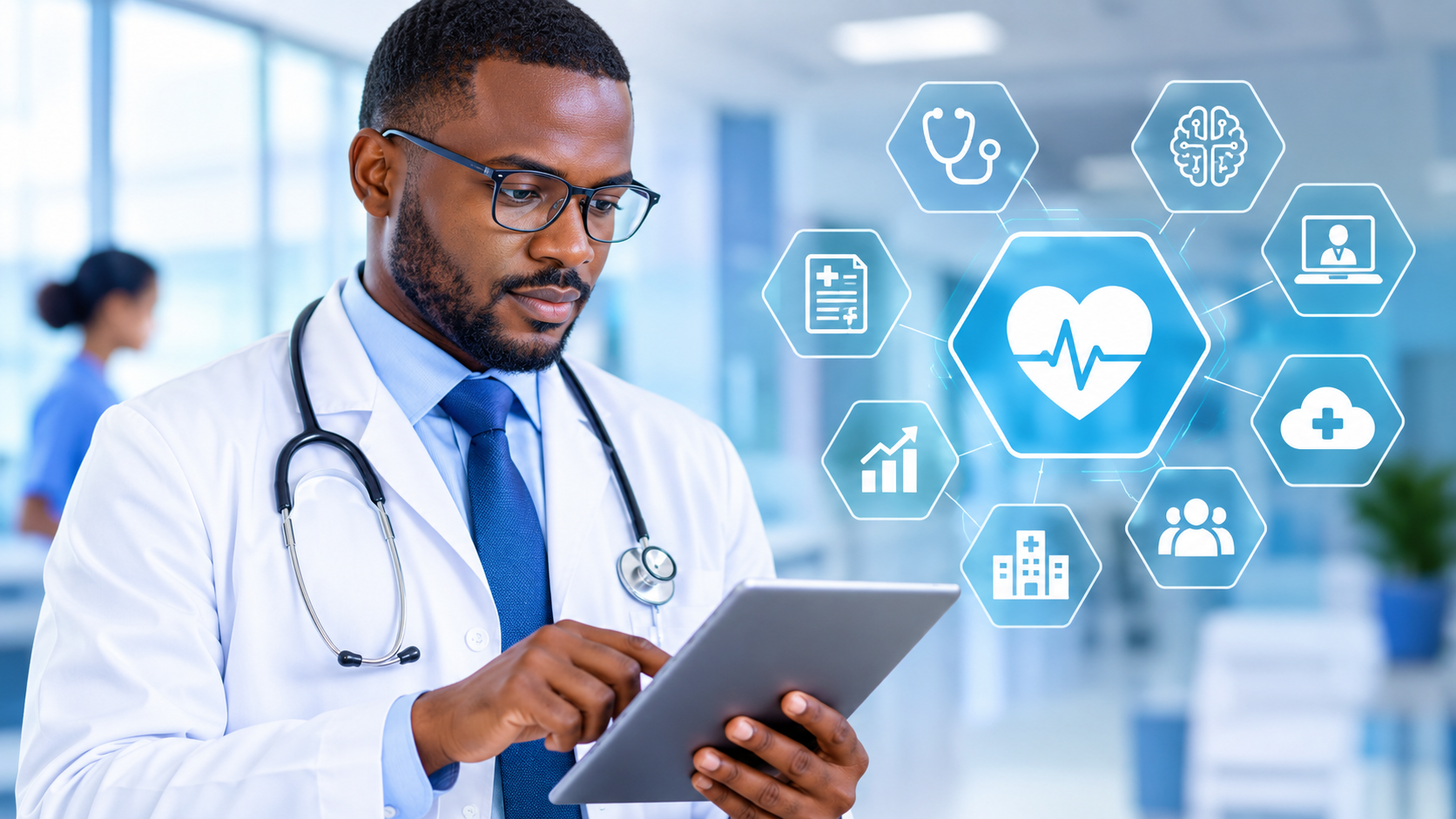
Medicine has always been a profession built on knowledge, evidence and continuous learning. But today’s healthcare environment is changing faster than ever. A modern doctor is no longer expected to rely only on clinical knowledge and traditional medical practice. Doctors increasingly need to understand digital health, artificial intelligence (AI), telemedicine, electronic health records, cybersecurity, data analytics and emerging medical technologies.
The World Health Organization (WHO) describes digital technologies as increasingly integral to healthcare and is encouraging health systems to use them to improve access, efficiency and people-centred care.
At the same time, technology should not replace the doctor. Rather, it should help doctors make better decisions, reduce unnecessary workload and spend more time focusing on patients.
Here are 12 important areas every modern doctor should pay attention to.
1. Develop Digital Health Skills
Digital health is no longer an optional area of healthcare. Doctors should understand how digital systems are transforming patient care, medical records, communication, diagnostics and healthcare management.
A modern doctor should be comfortable using electronic health records (EHRs), digital diagnostic systems, patient portals, electronic prescriptions and other healthcare platforms.
The goal is not simply to know how to operate software. Doctors should understand how digital tools affect clinical workflows, patient safety, data quality and decision-making.
Area for improvement: Doctors should seek regular digital-health training instead of waiting for their hospitals or employers to introduce new systems.
2. Understand Artificial Intelligence in Medicine
Artificial intelligence is becoming one of the most important healthcare technology trends.
AI is already being explored and deployed across areas such as medical imaging, clinical decision support, drug development, disease surveillance, documentation and healthcare administration. WHO notes that AI has potential across diagnosis, clinical care, drug development and health-system management.
However, doctors should not blindly trust AI-generated recommendations.
The modern physician needs to understand:
- What AI can and cannot do
- How AI recommendations are generated
- The possibility of inaccurate or biased outputs
- When human clinical judgment must take priority
- How patient information should be protected when using AI tools
The FDA also maintains a list of AI-enabled medical devices authorised for marketing in the United States, reflecting the growing role of AI in regulated medical technology.
Area for improvement: Learn to use AI as a clinical assistant—not as a replacement for clinical judgment.
3. Master Telemedicine and Virtual Care
Telemedicine has changed how patients can access healthcare.
A modern doctor should understand how to conduct effective consultations through approved telemedicine platforms while recognising when a patient requires a physical examination, laboratory investigation or emergency care.
Virtual healthcare can be particularly valuable for:
- Follow-up consultations
- Chronic disease management
- Specialist consultations
- Rural and underserved communities
- Medication reviews
- Health education
However, telemedicine also requires strong communication skills because the doctor may not have the benefit of a physical examination.
Area for improvement: Doctors should develop better virtual consultation techniques while understanding local regulations, privacy requirements and clinical limitations.
4. Become More Data-Literate
Healthcare is increasingly data-driven.
Doctors encounter patient data from laboratory systems, imaging equipment, EHRs, wearable devices, monitoring systems and public-health databases.
Therefore, modern doctors should understand basic concepts such as:
clinical data analysis, trends, risk factors, sensitivity, specificity, predictive value and evidence-based decision-making.
Doctors do not necessarily need to become data scientists. But they should be able to interpret healthcare data accurately and recognise misleading information.
WHO highlights the importance of translating data, research and evidence into action as part of digital health development.
5. Improve Cybersecurity and Patient Data Awareness
As healthcare becomes more digital, protecting patient information becomes increasingly important.
Doctors should understand basic healthcare cybersecurity principles, including secure passwords, access control, phishing awareness, device security and responsible handling of patient information.
A doctor may unknowingly create a security risk by sharing confidential patient information through an unsecured messaging platform, leaving a workstation unlocked or using inappropriate cloud services.
Area for improvement: Every doctor should receive basic cybersecurity and data-protection training as part of professional development.
6. Learn How Modern Diagnostic Technology Works
Medical equipment is becoming increasingly sophisticated.
From automated hematology analysers and clinical chemistry systems to molecular diagnostic platforms, digital pathology, ultrasound, advanced imaging and point-of-care testing, technology is changing diagnostic medicine.
Doctors do not need to become biomedical engineers, but they should understand the capabilities and limitations of the diagnostic tools they use.
A modern doctor should be able to ask:
- How accurate is this test?
- What are its limitations?
- When should it be requested?
- How should the result be interpreted?
- Could technical or pre-analytical factors affect the result?
This helps prevent technology from becoming a substitute for clinical reasoning.
7. Strengthen Evidence-Based Practice
Healthcare trends come and go. A modern doctor must be able to distinguish between genuine medical innovation and technology hype.
Before adopting a new device, app, diagnostic test or AI system, doctors should consider the available clinical evidence.
Ask:
Does it improve patient outcomes? Is it safe? Is it validated? Is it cost-effective? Does it improve the patient experience?
WHO has emphasised the importance of evidence-based adoption of digital health solutions and appropriate governance.
Area for improvement: Develop the habit of reading current clinical guidelines, systematic reviews, peer-reviewed research and reputable medical publications.
8. Develop Stronger Patient Communication Skills
Technology should make healthcare more human—not less human.
A doctor can have access to sophisticated AI, EHRs and diagnostic equipment and still provide poor care if communication with the patient is inadequate.
Modern patients increasingly research their symptoms online and may arrive with information from social media, health apps and AI platforms.
Doctors therefore need to be able to:
- Listen without immediately dismissing the patient
- Correct misinformation respectfully
- Explain complex medical concepts simply
- Discuss treatment options clearly
- Encourage shared decision-making
Area for improvement: Improve health communication and digital health literacy alongside technical skills.
9. Learn to Manage Technology Without Increasing Burnout
One of the biggest challenges of modern healthcare is that technology can sometimes create more work rather than less.
Electronic health records, documentation requirements, alerts, inboxes and administrative tasks can contribute to physician stress. The AMA reports that physicians identify administrative burden as one of the major opportunities for AI to address, with 57% of surveyed physicians identifying it as the biggest opportunity in its 2024 survey.
Doctors therefore need to learn how to use technology strategically.
The question should not be:
“What new technology can we use?”
Instead:
“What problem are we trying to solve, and will this technology actually solve it?”
10. Embrace Continuous Professional Development
The medical degree is the beginning of a doctor’s learning journey—not the end.
With healthcare technology evolving rapidly, doctors should continuously update their knowledge through:
- Conferences
- Workshops
- Online medical courses
- Clinical journals
- Professional associations
- Technology training
- Peer learning
- Research
WHO projects a global health-worker shortfall of around 11 million by 2030, particularly affecting low- and lower-middle-income countries.
This makes continuous professional development even more important. Healthcare systems need doctors who can adapt, learn new technologies and work efficiently within changing environments.
11. Understand Remote Patient Monitoring and Wearable Technology
Smartwatches, connected medical devices, home blood-pressure monitors, glucose monitoring systems and other wearable technologies are generating increasing amounts of health information.
Remote patient monitoring can support the management of conditions such as hypertension, diabetes and certain cardiovascular conditions.
However, more data does not automatically mean better healthcare.
Doctors must understand:
- Which measurements are clinically useful
- Whether a device is reliable
- How abnormal readings should be verified
- When patients require physical assessment
- How information should be integrated into clinical workflows
Area for improvement: Learn how to interpret relevant patient-generated health data without becoming overwhelmed by unnecessary information.
12. Become a Better Leader and Collaborator
The modern healthcare environment requires teamwork.
Doctors increasingly work alongside nurses, pharmacists, laboratory scientists, radiographers, biomedical engineers, health informaticians, IT professionals, data analysts and administrators.
Technology makes this collaboration even more important.
A doctor who understands the capabilities of other healthcare professionals can help create better clinical workflows and safer patient-care systems.
Modern healthcare leadership is therefore not simply about giving instructions. It is about communication, collaboration, innovation, accountability and continuous improvement.
The Modern Doctor Must Combine Medicine With Technology
The future of healthcare will not simply belong to doctors who know the most about technology. It will belong to doctors who know how to combine clinical expertise with technology, evidence, communication and human judgment.
AI will become more capable. Diagnostic equipment will become more automated. Telemedicine will continue expanding. Patient data will become more abundant. Digital health platforms will become more integrated.
But the fundamental role of the doctor will remain critical.
Technology can process information.
AI can identify patterns.
Machines can perform tests.
Software can automate documentation.
But compassionate clinical judgment, ethical responsibility, communication and understanding of the individual patient remain deeply human responsibilities.
The modern doctor should therefore ask one important question continuously:
“How can I use today’s technology to become a better doctor and provide better care for my patients?”
That mindset—rather than simply chasing every new technology trend—is what will help doctors remain relevant, effective and prepared for the future of healthcare.
